ASSOCIATION DES AMIS DE L'ART DE MARCEL DUPRÉ

aaamd75@orange.fr
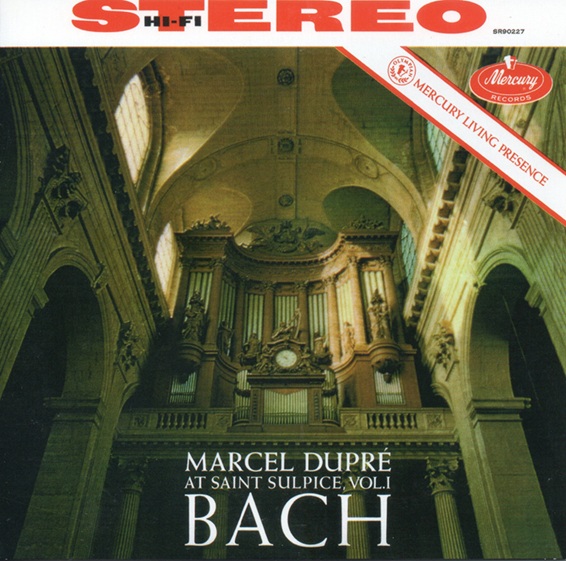
We note with great pleasure the publication in the February 2026 issue of The Diapason the essay by Thomas Chase on the subject of Dupré's invaluable Mercury recordings made in 1957 and 1959.
To know the promotional offers regarding these Mercury Living Presence CDs (until March 31, 2026), click here.
Nous notons avec grand plaisir la publication dans le numéro de février 2026 de The Diapason de l'article de Thomas Chase à propos des inestimables enregistrements Mercury Living Presence de Dupré réalisés en 1957 et 1959.
Pour connaître les offres promotionnelles concernant les CD Mercury Living Presence (jusqu'au 31 mars 2026), cliquez ici.
"One of Music's True Immortals"
Notes on Marcel Dupré and the Legendary Mercury recordings of 1957 and 1959 Thomas Chase
The Mercury recordings of 1957 and 1959 allow us to hear late vestiges of the mastery that, from 1912 onward, brought Dupré unparalleled plaudits from critics, colleagues, students, and concert audiences around the world. To his teacher Louis Vierne, Dupré was "an artist with absolutely exceptional powers of interpretation, gifted with unrivalled execution." To his student Olivier Messiaen, he was "the modern Liszt," "the greatest organ virtuoso ever to exist," and "a very great composer."
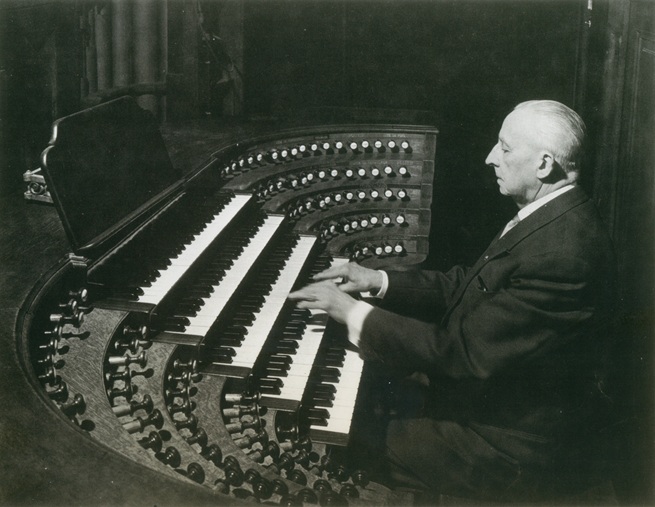
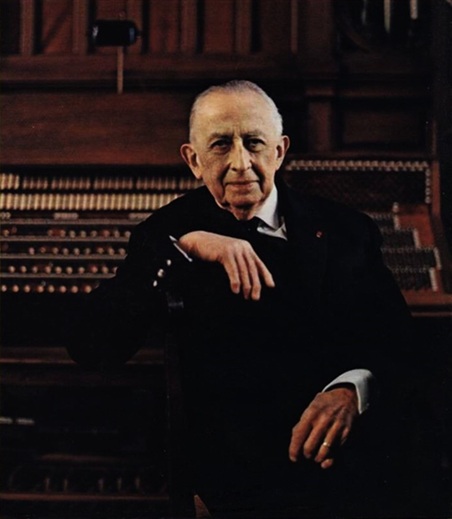
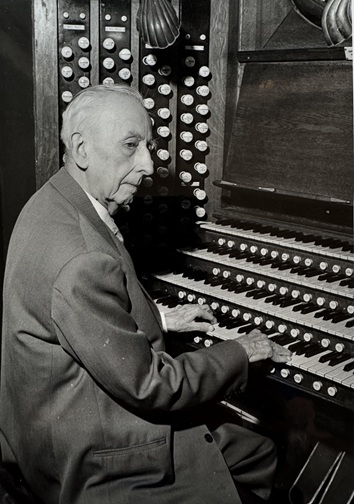
Throughout his career, superlatives abounded. The Sorbonne's Henri de Rohan-Csermak wrote of the "emperor-like image he had gained from his almost half-century reign over the field of the organ." Ely Cathedral organist Arthur Wills declared Dupré "the foremost virtuoso and organist-composer of his time." Rollin Smith argued that "[m]any considered him, as did Widor, the greatest improviser since Bach." And more recently in The New Criterion, critic Nathan Stewart described Dupré as "a genius performer, scholar, and teacher, as well as a composer who bridged the gap between the Romantic and Modern eras." But the truism "time waits for no man" is inescapable. Though Dupré's Mercury recordings - both those made in America and those made in Paris - together constitute the most substantial range of repertoire he committed to disc, they inevitably reflect his advanced age, and most directly the state of his hands. Despite retakes and many edits, slips, split notes, and occasional rhythmic unsteadiness can be heard. Biographer Michael Murray tells us that in the early 1950s Dupré received devastating medical news. His doctor identified the onset of ankylosis, a hereditary disease of the joints that would cripple his hands just as, decades earlier, it had crippled his cellist mother's. Photographs from late in his life show its effects. By the mid-1950s, his fingers increasingly stiff and gnarled, the peerless virtuosity of his earlier years is constrained. "Through physical incapacity," wrote Arthur Wills, "the performances of his last years gave little idea of his consummate technique, or the superb musicianship so evident throughout most of his career." At the same time, however, the Mercury recordings - comprising more than thirty works by Bach, Franck, Saint-Saëns, Widor, Messiaen, and Dupré himself - affirm that despite his struggles with his hands, Dupré's interpretive intellect and sheer force of will remained undimmed, as did his rhythmic drive and imperious command of musical line. Above all, Dupré's performances as captured on these recordings are imbued with a grandeur and nobility that remain uniquely his. Even in his final years, his interpretations and improvisations bore witness to the dictum of his mentor Charles-Marie Widor: "Organ playing is the manifestation of a will filled with the vision of eternity." For today's readers and listeners, therefore, the following pages offer a biographical overview as essential context for Dupré's eight Mercury discs from Detroit, New York, and Paris. 1912-1920: The Opus 7 Préludes et Fugues, the Bach intégrale, and an international debut
At 8:00 pm on Thursday 9 December 1920 in London's Royal Albert Hall, before an audience of nearly ten thousand including members of the royal family, Dupré took his bow and sat down at the console. His performance that evening of the commissioned work, the Vêpres du Commun des Fêtes de la Saint Vierge, Opus 18, launched a half-century's touring, performing, broadcasting, and teaching around the world.
As if that were not enough, earlier in 1920 Dupré had astonished the musical establishment with an historic achievement - the first performance of the entire organ œuvre of Bach, some two hundred works played from memory in ten weekly concerts. For Vierne, it was "the greatest artistic feat accomplished by a virtuoso since the King of Instruments was first played." In London, The Musical Times reported: At the last of these recitals, given before an audience which included members of the Institut de France, many distinguished French musicians and the professors of the Conservatoire, M. Widor addressed the company, concluding with these words: "We must all regret, my dear Dupré, the absence from our midst of the person whose name is foremost in our thoughts today - the great Johann Sebastian himself. Rest assured that if he had been here he would have embraced you, and pressed you to his heart." In subsequent years Dupré repeated the memorized intégrale several times. His concert programs almost invariably featured one or more major Bach works, always played from memory. 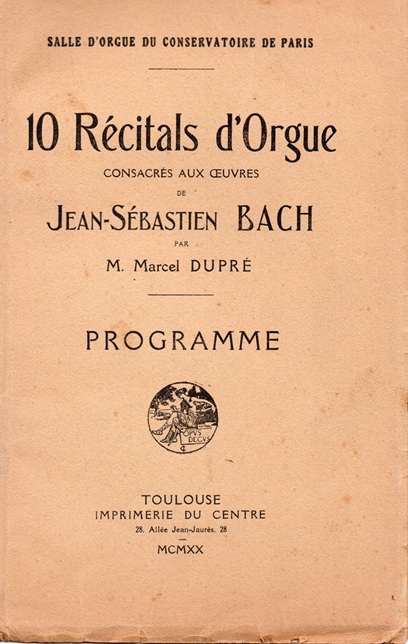
Title page of program, 1920 Bach recitals in Paris
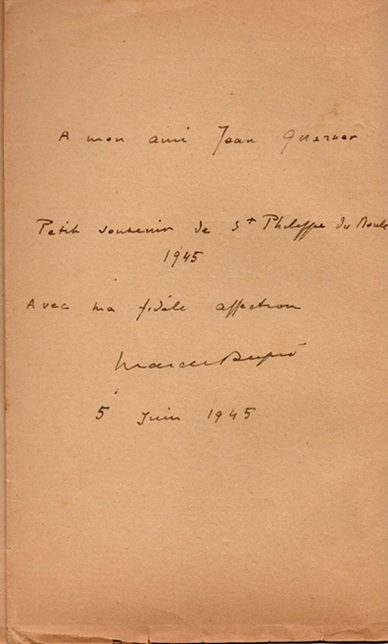
Dedication by Dupré to his friend Jean Guerner during Bach integrale at Saint-Philippe-du-Roule in Paris, 1945 Courtesy: Bruno Chaumet 1920-1939: "The Modern Liszt" For Dupré, the 1920s were a decade of intense activity and travel - and enormous accomplishments in performance, composition, and teaching. Extensive tours of Europe and especially of North America earned him both a global reputation and substantial wealth. With scheduled airline service in its infancy, his tours of the United States and Canada in the 1920s relied on rail travel. A single tour could involve journeys to as many as 110 concert venues spread across the continent. For Dupré, this meant travelling overnight on a sleeper car, preparing and performing a memorized program on an unfamiliar instrument, accepting themes from local musicians for the improvisation of a symphony or other major form, participating with French politesse in a post-concert reception, and then departing for the next city on his tour. Meeting these challenges required unusual reserves of patience, energy, and intense focus. The reward was fame and fortune unlike anything previously experienced by an organ virtuoso and composer. 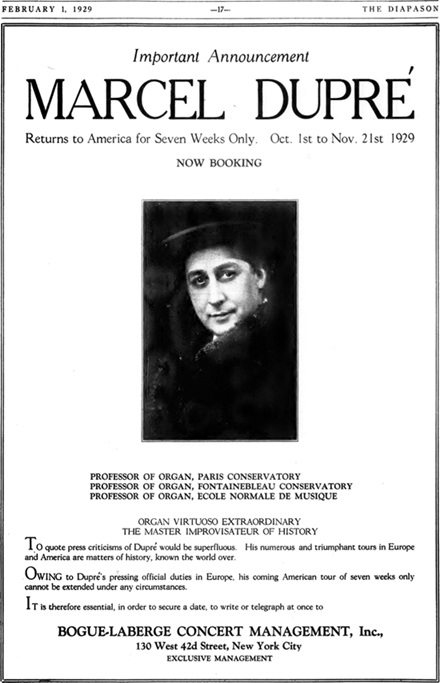
Tour advertisement, February 1929 Reproduced from The Diapason, with permission of Organ Legacy Media, LLC
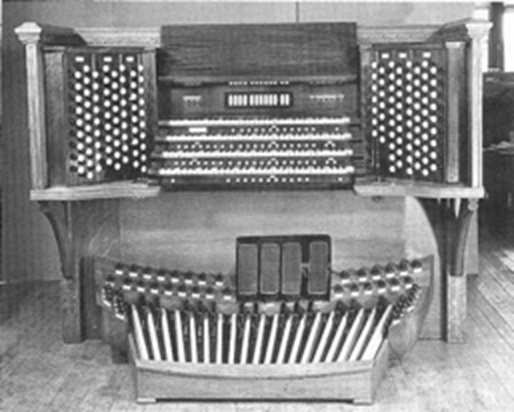
His newfound wealth enabled the purchase of a large villa in the Parisian suburb of Meudon. To it he added a 200-seat concert hall or salle d'orgue housing his teacher Guilmant's Cavaillé-Coll organ, which he later expanded to four manuals and to which he added numerous registrational aids. (These devices were several decades ahead of their time, including sostenutos reintroduced by organ builders only in the last few decades. Another was the coupure pédale, a device permitting the player to "divide" the pedalboard and assign different registrations to the left and right feet. A generation later, Dupré's student Pierre Cochereau adopted the coupure in the new console for the Notre-Dame Cathedral organ, where the musical textures it made possible quickly became a key feature of his remarkable liturgical improvisations.)
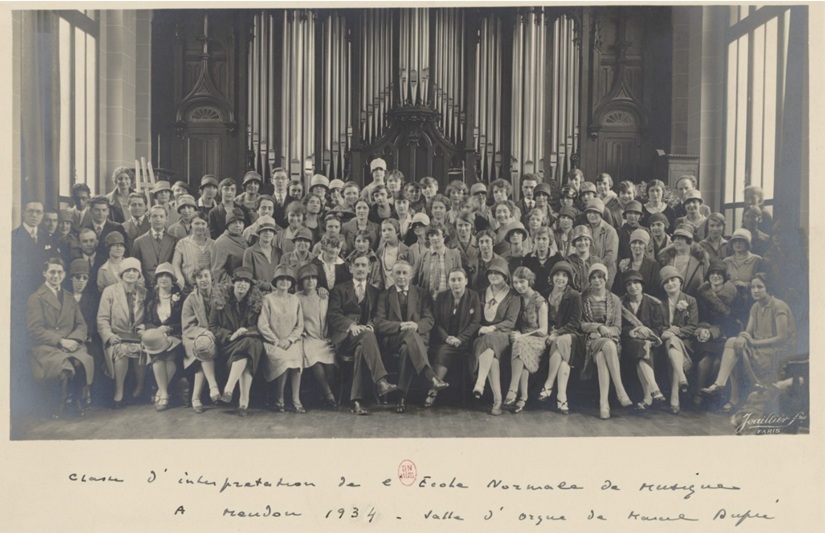
Dupré (center front) in his salle d'orgue at Meudon with students of the École Normale, 1934 Source gallica.bnf.fr/Bibliothèque nationale de France
1940-1956: World War II; directorship of the Conservatoire; retirement
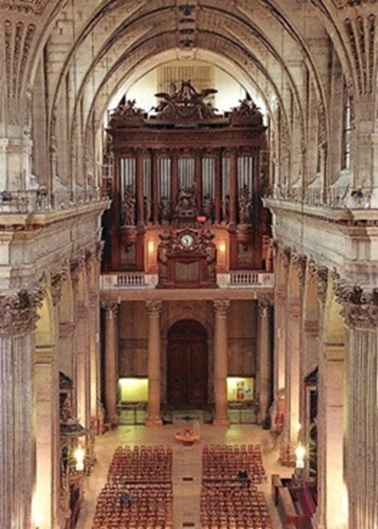
The German occupation prevented Dupré from touring outside France. He continued to play concerts, compose, and teach at the Conservatoire. On Sundays, together with his wife Jeanne he walked the five miles from their Meudon home to play services at Saint-Sulpice. His intensive wartime mentorship of the prodigy Jeanne Demessieux deserves (and has received) lengthier discussion elsewhere. Indeed, readers who seek a broader understanding of Dupré's playing, teaching, and aesthetic are urged to read Demessieux's diaries in their entirety. They cast a singularly vivid light not just on Dupré, his aesthetic, and his compositions, but also on the bitter rivalries roiling the French organ world in the 1940s. The following diary entry from Sunday 13 August 1944, less than two weeks before French and American troops liberated Paris from the Nazis, captures the febrile atmosphere in the city and the effect Dupré's playing had on audiences. Demessieux writes:
And given the acute problems Dupré was by then experiencing with his hands, it is difficult to understand how he remained physically capable of recording his Prélude et Fugue en sol mineur, Opus 7/3, at a tempo that challenges young virtuosi even today. A few hours after the final Mercury recording session ended at 2:30 am, Dupré and his wife returned to the church to prepare for his evening concert. After a full day of rehearsal on the Aeolian-Skinner instrument, the Duprés left for dinner. "At 8 pm," Jeanne Dupré wrote, "we returned to St Thomas, a stone's throw from the restaurant. The concert was due to begin at 8:30, but already the vast church was full: on the ground, in the galleries, in the choir section." In his own memoirs, the organist of St Thomas Church, William Self, wrote, "Dupré walked to the console as if he had never a care nor a worry, sat down, and started to play - a magnificent recital, fully justifying the expectations of his audience." Jeanne Dupré concluded her diary entry for 17 October 1957 thus: "Words cannot express the grandeur and beauty of this concert. I have never heard Marcel more dazzling." 1959: The Mercury recording team travels to Paris So successful were the New York and Detroit recordings that Mercury signed Dupré to record another five LPs on the instrument that he had played for more than a half-century, the monumental five-manual Clicquot/Cavaillé-Coll organ in the Church of Saint-Sulpice. In late June 1959, Mercury shipped its recording van across the Atlantic, and the five discs of repertoire by Bach, Franck, Dupré, and Messiaen were recorded in nighttime sessions between 3 and 12 July that warm summer.
And as with the Suite from 1944 and the Deux Esquisses from 1945, we encounter in Opus 36 textures and sounds never before heard in the organ repertoire. Recording these works in the 1980s, Swedish organist Torvald Torén characterized the A-flat prelude and double fugue, Opus 36/2, as "counterpoint on the level of Bach." Indeed, for many listeners the final pages of the A-flat double fugue are among the finest moments in organ recording, a monument of learned and intricate counterpoint moving inexorably toward a blazing conclusion.
Indeed, over the centuries we often witness a new generation reject the aesthetic of its teachers, striking out in new directions. But as history shows, those new directions will in turn be rejected and replaced - not infrequently by a return to the aesthetic of a more distant past. This essay is therefore not the place to debate the "authenticity" of the 73-year-old Dupré's performance of Bach and Franck, nor to evaluate competing claims of a "true" tradition of playing Bach or Franck passed down through the generations from teacher to pupil. Neither Bach nor Franck, needless to say, left us recordings that would enable us to verify these claims. Both, however, taught students who claimed in good faith to have inherited their masters' manner of playing. Alas, the interpretive approaches of even these first-generation students are often at odds, to say nothing of second- and third-generation successors. Compare, for example, the 1975 recording of Dupré's works on the FY label by his student Pierre Cochereau to one by Dupré's grand-student (via Éliane Lejeune-Bonnier) Yves Castagnet on the Sony label in 1993. Castagnet provides extremely restrained, literal readings, staying very close to Dupré's scores and achieving reference-level performances worthy of careful study. Cochereau's 1975 recording, on the other hand, makes substantial changes to the score's indications of tempo, registration, and even rhythm. In his liner notes, Cochereau indicates that Dupré personally gave him approval to make these interpretive changes. Indeed, we know that over the decades even Dupré's recordings of his own works departed, at times in dramatic ways, from his published scores. Compare, for example, in the St Thomas recording his treatment of the closing bars of the Fugue en sol mineur, Op 7/3. Dupré shortens the final chords dramatically from the values in the published score - using the Aeolian-Skinner's cohesive attack and the church's acoustic to generate greater impact, even ferocity.
Among the Franck works Dupré recorded at Saint-Sulpice during the July 1959 sessions, the Grande Pièce Symphonique and the Fantaisie in A are especially recommended. Here it is appropriate to acknowledge that, for many, the high point of mid-20th-century Franck interpretations is the intégrale by Dupré's student Jeanne Demessieux, recorded for Decca that same month, July 1959, just a few miles away at the Église de la Madeleine. Indeed, Demessieux's recording of Franck's Prière, Opus 20 (1862) remains, for many, unequalled in its emotional intensity and sheer poetic beauty. Yet seventeen years prior to her Decca sessions, Demessieux wrote in her diary entry for Friday 19 June 1942:
Their performances and writings, many of them available online, are now attracting new audiences to Dupré's music and aesthetic. At the same time, moreover, the artistry of this new generation inspires us to revisit a recorded legacy that remains without peer, and that will always have much to teach, delight, and move us. The Mercury recordings of 1957 and 1959 form an essential part of that legacy.
For suggesting references as well as providing comments on earlier drafts,
the author thanks Michael Barone, David Briggs, Bruno Chaumet, Thomas Fine, Paul Hale, G. B. Henderson, Mark McDonald, Thomas Murray, and Brenda Righetti. Remaining inaccuracies are his responsibility. The Mercury CDs discussed in this essay are available from the Association des Amis de l'Art de Marcel Dupré in Paris, order codes 350140-350147. François-Michel Rignol's CD of Dupré's piano works is also available from the AAAMD. For information on the recent boxed set including DVD, CD, and booklet, see the second entry below. 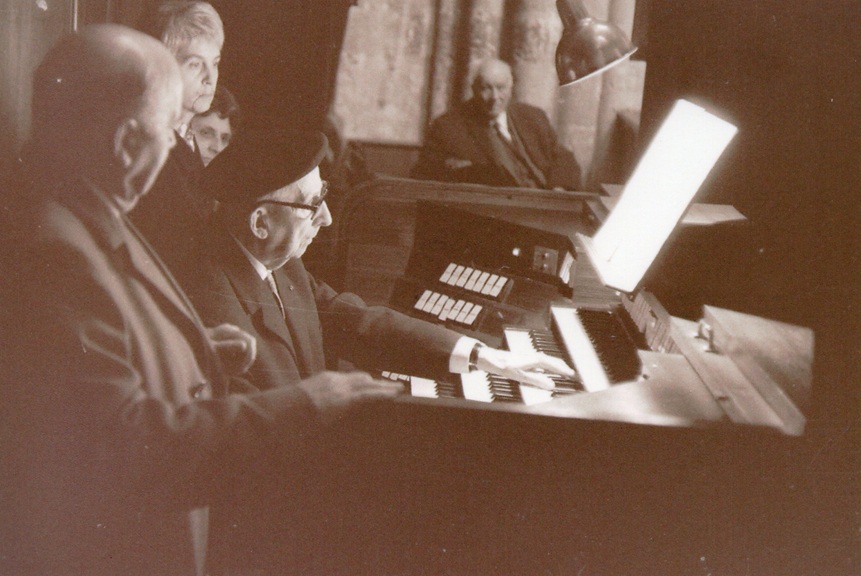
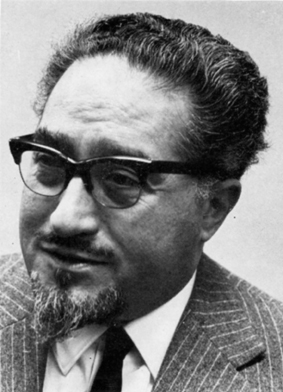
Dupré at Rouen Cathedral on 11 April 1969 improvising on submitted themes, with (L-R) his student Marcel Lanquetuit (organist of the cathedral),
Lanquetuit's successor Marie-Thérèse Duthoit, Marthe Brasseur, and M. Godart Photographer: Fritz Bernhard Courtesy: AAAMD Essay and sources last updated 10 November 2025 Further reading, listening, and viewing Readers new to Dupré and the Mercury recordings are encouraged to begin their researches with four principal sources: Michael Barone's invaluable Pipedreams programs on National Public Radio; Tobias Frank's twelve-part Dupré Digital series on YouTube; Bruno Chaumet's essay on Dupré; and the 2nd edition of Michael Murray's biography, available from the AAAMD and the Organ Historical Society.
Archer, J. Stuart. "Marcel Dupré: An Appreciation." London: The Organ 2:6-8, 1922-23.
Association des Amis de l'Art de Marcel Dupré and Decca Music Group. Marcel Dupré: Saint-Louis-des-Invalides. Boxed set including DVD, CD, and 72-page booklet, order code 350302. Also available in the United States and Canada from the Organ Historical Society, Marcel Dupré - Saint-Louis-des-Invalides. "B." "Marcel Dupré: The Man and his Music." London: The Musical Times 61:934, December 1920. Barone, Michael. Pipedreams, (American Public Radio). A superb archive of concert programs and commentary, with numerous episodes on Dupré. Of particular note is program #1618, dated 1 May 2016. In that episode, Michael converses with Bruno Chaumet, President of the AAAMD; audio engineer Thomas Fine, whose parents Robert and Wilma were responsible for the sound of the original 1957 and 1959 recordings; and project consultant Adam Freeman. Between 1986 and 1999, Barone and his Pipedreams colleagues produced a remarkable 8-part series titled "The Dupré Legacy." It includes programs #8617 (27 April 1986) with Dupré biographer Michael Murray; #8618 (4 May 1986); #8633 (17 August 1986); #8651 (21 December 1986); #8713 (29 March 1987); #8718 (3 May 1987); #9917 (25 April 1999); and #8819 (8 May 1988). There is also a "homage to Dupré" in program #9420 (15 May 1994) and a complete performance, with plainchant, of the Vêpres du Commun, Opus 18, the work that Dupré premiered at London's Albert Hall in 1920. Readers will also wish to listen to program #0118, dated 29 April 2001, and program #1418, dated 4 May 2014. In both, Jeremy Filsell, who recorded Dupré's complete œuvre for Guild, plays and discusses the music. Baskeyfield, David. "Dupré: The American Experience." Acis CD APL67072, 2019. Castagnet, Yves. Marcel Dupré : Symphonies pour Orgue. Sony CD SK 57485, 1993. Cavanagh, Lynn. "Marcel Dupré's 'Dark Years': Unveiling his Occupation-Period Concertizing." Intersections: Canadian Journal of Music 34:1-2, 2014. Cavanagh, Lynn, and Stacey Brown. The Diaries and Selected Letters of Jeanne Demessieux (cf. also L'Orgue 287-288, 2009). Chaumet, Bruno. "Marcel Dupré, 3 May 1886 - 30 May 1971." In booklet accompanying the boxed set Marcel Dupré: the Mercury Living Presence Recordings. Paris: l'Association des Amis de l'Art de Marcel Dupré and Decca Music Group, 2015. Clark, Tom. "Holst in an Unusual Circle." British Association of Friends of Museums Journal 115 (Winter 2015/16): 14. Cochereau, Pierre. Le Point d'Orgue, televised interview from December 1959 (https://www.youtube.com/watch?v=B__Tac4cxpI&list=RDB__Tac4cxpI&start_radio=1). Cochereau, Pierre. Dupré: Organ Works. Solstice CD FYCD 820, 1975. Delestre, Robert. L'Œuvre de Marcel Dupré. Paris: Editions Musique Sacrée, 1952, (this book is available from the AAAMD, order code 350203). Demessieux, Jeanne. See Cavanagh, Lynn, and Stacey Brown. Demessieux, Jeanne. César Franck: Intégrale de l'Œuvre pour Orgue. Recorded at the Church of the Madeleine, 1959. Festivo CD 155 and 156, 199x. Dupré, Jeanne. "Trip to America in 1957: Extracts from the Diary of Mme Jeanne Dupré." In booklet accompanying the boxed set Marcel Dupré: the Mercury Living Presence Recordings. Paris: l'Association des Amis de l'Art de Marcel Dupré and Decca Music Group, 2015. Dupré, Marcel. Silent film, Paris, 1920 (https://www.youtube.com/watch?v=Xv3wfbdHQVM). Dupré, Marcel. Marcel Dupré raconte. Paris: Bornemann, 1972. English translation by Ralph Kneeream (Recollections, Belwin-Mills, 1975); German translation by Hans Steinhaus (Erinnerungen, Merseburger, 1981). Dupré, Marcel. Souvenirs. Paris: Association des Amis de l'Art de Marcel Dupré, 2007, order code 350213. Dupré, Marcel. Recital at Hammond Castle Museum (Bach, Handel, Franck, Dupré, improvisation on a theme by T. Tertius Noble), 5 August 1948 (Improvisation at Hammond Castle Museum: https://www.youtube.com/watch?v=yJnZnaM7E6I). Dupré, Marcel. Interview at Carleton College, Northfield, MN. 10 November 1948 (https://www.youtube.com/watch?v=7nqCYH_P5o4). Dupré, Marcel. The Stations of the Cross, Opus 29. Stephen Tharp, organist. JAV Recordings JAV161, 2005. Dupré, Marcel. L'Œuvre pour Piano. François-Michel Rignol, piano. Disques FY and DU Solstice / Delmas Musique SOCD 348, 2017, (this CD is available from the AAAMD, order code 350148). Dupré, Marcel. Piano and Chamber Works. Philip Nixon, violin; Rosanne Hunt, cello; Harold Fabrikant, piano. Toccata Classics TOCC 0755, 2025. Eschbach, Jesse. Marcel Dupré: His Legacy Considered 50 Years after his Death (https://theleupoldfoundation.org/2022/02/01/marcel-dupre-his-legacy-considered-50-years-after-his-death/). Estang, Flore. Musicians in the Great War: Marcel Dupré's Vespers, Musicologie.org, 21 February 2016. Falcinelli, Rolande, et al. Marcel Dupré: Biography, Technique, Aesthetics, Press Notices in Musica et Memoria. Filsell, Jeremy, with Jeremy Backhouse and the Vasari Singers. The Life and Music of Marcel Dupré. Contains a valuable discussion of Dupré's career and music by a leading Dupré interpreter and scholar (https://www.youtube.com/watch?v=VBdsk7kjr2U). Filsell, Jeremy. See also Barone, Michael, and Stewart, Nathan C. Fine, Thomas. "Recording Marcel Dupré." In booklet accompanying the boxed set Marcel Dupré: the Mercury Living Presence Recordings. Paris: l'Association des Amis de l'Art de Marcel Dupré and Decca Music Group, 2015. Forman, Lewis and Susan (eds.). Felix Aprahamian: Diaries and Selected Writings on Music. Rochester: Boydell and Brewer, 2015. Franck, César. Prière, Opus 20 (1862). Decca recording of Jeanne Demessieux playing the organ at l'Église de la Madeleine, Paris, 1959 (https://www.youtube.com/watch?v=d4SXLLhUcFs). Franck, César. See Demessieux, Jeanne. Frank, Tobias. Dupré Digital: A Man Between the Centuries, (twelve episodes). Freeman, Adam. "Marcel Dupré and the [Mercury] Recordings." In booklet accompanying the boxed set Marcel Dupré: The Mercury Living Presence Recordings. Paris: l'Association des Amis de l'Art de Marcel Dupré and Decca Music Group, 2015. Gavoty, Bernard. Marcel Dupré. Geneva: Editions René Kister, 1957, (this book is available from the AAAMD, order code 350204). Hammond, Anthony. Pierre Cochereau, Organist of Notre-Dame. Rochester: University of Rochester Press, 2012. Hunt, Donald. Bach and Dupré: Métrise et Maître [includes Opus 7/2 and Dupré's arrangement of Bach's Sinfonia from Cantata 29.] 12 June 2021 concert at Christ Church Cathedral, Victoria, Canada (href="https://youtu.be/8w-Vwu-jB4Y?t=397). Johnson, Claude Goodman. Letter written from the Ritz-Carleton Hotel, New York, to Douglas Johnson, Manchester, 5 January 1921. Unpublished typescript courtesy of Thomas Murray. McDonald, Mark. The Art of Impossible [includes Opp. 7/1 and 7/3], 26 June 2021 concert at Christ Church Cathedral, Victoria, Canada (https://youtu.be/Vlejc9Miga8?t=353). Murray, Michael. Marcel Dupré: The Work of a Master Organist. 2nd ed. Paris: Association des Amis de l'Art de Marcel Dupré, 2020, (order code 350225), (First edition - Boston: Northeastern University Press, 1985). Murray, Thomas. "Claude Goodman Johnson, Patron of Fine Arts and Benefactor of Marcel Dupré." Organists' Review 90 (2004): 354. Robert, Michel. Pierre Cochereau and Improvisation: A Composer in the Moment. English translation by David Briggs and Thomas Chase. Paris: Delatour France, 2026. Rohan-Csermak, Henri. Notes to Yves Castagnet's Marcel Dupré : Symphonies pour Orgue. Sony CD SK 57485, 1993. Self, William. For Mine Eyes Have Seen. AGO Worcester Chapter, 1990. Smith, Rollin. "Feature Review: Legendary Recordings of Marcel Dupré." The Tracker (Summer 2017). Smith, Rollin. An Introduction to the Organ Music of Marcel Dupré. The Leupold Foundation, 2020. Smith, Rollin. Dupré in the '20s, Marcel Dupré 50th Celebration. The Leupold Foundation, 2021 (https://theleupoldfoundation.org/2022/02/03/dupre-in-the-20s/). Stewart, Nathan C. "Surpassing Beauty: On the Composer Marcel Dupré and an Organ Concert by Jeremy Filsell." The New Criterion 44.1 (September 2025). Tharp, Stephen. Le Chemin de la Croix, Opus 29. Recorded in Saint-Sulpice. JAV CD161, 2005. Torén, Torvald. Dupré: Symphonie-Passion, Trois Préludes et Fugues Opus 36, Evocation. Proprius PRCD 9003, 1989. Trieu-Colleney, Christiane. Jeanne Demessieux: Une Vie de Luttes et de Gloire. Les Presses Universelles, 1977. Vierne, Louis. Mes Souvenirs. Paris: Bulletin de Les Amis de l'Orgue, 1934-1937. Reissued (ed. Norbert Dufourcq) in L'Orgue, 1970. Wills, Arthur. "Marcel Dupré" [obituary]. London: The Musical Times, July 1971: 693. |